






















In the latest of a series of real asset investment case studies, Robyn MacHugh, Associate Director at Gravis Capital Management, looks at electric vehicle charging.

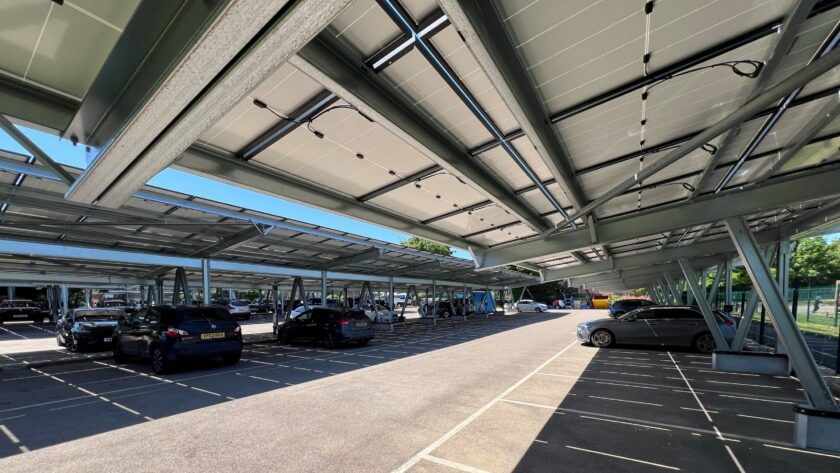
The first electric vehicle charging investment made by GCP Infrastructure Investments Ltd (GCP) was in 2023. The Company funded the build-out of rooftop solar assets on existing car park infrastructure on public sector sites in the UK, whilst providing electric vehicle (EV) charging points (CPs) for staff and visitors.
The investment case
Solev Energy Group is a UK-based manufacturer specialising in sustainable, net zero carbon buildings and infrastructure for the education sector.
The project, named SolarCatcher, is a fresh approach to the energy transition, as it uses existing car park infrastructure to generate on-site renewable energy for schools and academies, whilst providing electric vehicle charging points for staff and visitors.
There is no upfront cost for the schools and academies to install the infrastructure, and they are able to benefit from lower energy bills.
For GCP, the rationale behind entering this sector through this investment was driven by the long-term contracted revenues with a public sector counterparty, with the additional benefit of a revenue-share scheme for the charging revenues.
How revenue is derived
As part of the financing, each school enters into a power purchase agreement with SolarCatcher under which they purchase power produced by the solar panels for use within the school, thereby reducing the power they need to draw from the electricity grid.
These power purchase agreements are executed for a fixed price which is lower than the price the schools pay to their usual supplier.
Therefore, the agreement with SolarCatcher not only provides certainty of cost and is a source of energy, it also ensures lower energy bills, which is particularly important given the current strain on public budgets.
In addition, SolarCatcher has agreed a gainshare mechanism with the schools, whereby they benefit from a percentage of the profits generated by the electric vehicle chargers.
This allows the schools to earn money from the use of the chargers which can then be re-invested into school projects, improving wider infrastructure and benefitting communities.
How the sector could evolve
The UK Government is currently consulting on the introduction of mandates or incentives for the installation of solar canopies on new car parks, mirroring policies already implemented in countries such as France.
Integrating solar canopies with co-located EV charging infrastructure creates clear operational efficiencies, including reducing reliance on grid electricity and lowering the carbon intensity of charging, ultimately lowering operating costs for site owners.
As part of its commitment to achieving net zero emissions by 2050, the UK Government intends to end the sale of new petrol and diesel cars by 2030.
This policy will significantly increase demand for EV charging infrastructure, and to support widespread adoption, charging must be as convenient and accessible as possible, making destination charging, where vehicles are charged at their end location, such as workplaces, retail centres or hotels, critical to EV uptake.
Workplaces are particularly well suited for destination charging, as vehicles are typically parked for extended periods during the working day.
Access to workplace charging will be especially important for drivers who lack off-street parking or home charging facilities. As a result, this segment of the market presents substantial long-term growth potential and investment opportunities.
Important Information:
No information contained in this article should be construed as providing financial, investment or other professional advice and should not be considered as a recommendation, invitation, or inducement to subscribe for, dispose of or purchase any such securities. Professional investors only. Capital at risk. Past performance is not a guide to future performance.