






















Professional Paraplanner’s TDQ (Training, Development and Qualifications) series, which is run in conjunction with key support providers, such as Brand Financial Training, aims to test your knowledge of the financial services market, as part of your overall training goals and exam techniques.
The following questions relate to examinable Tax year 20/21, examinable by the CII until 31 August 2022.
Published with every issue of the magazine and also online, the questions below are an extra set to test your knowledge.
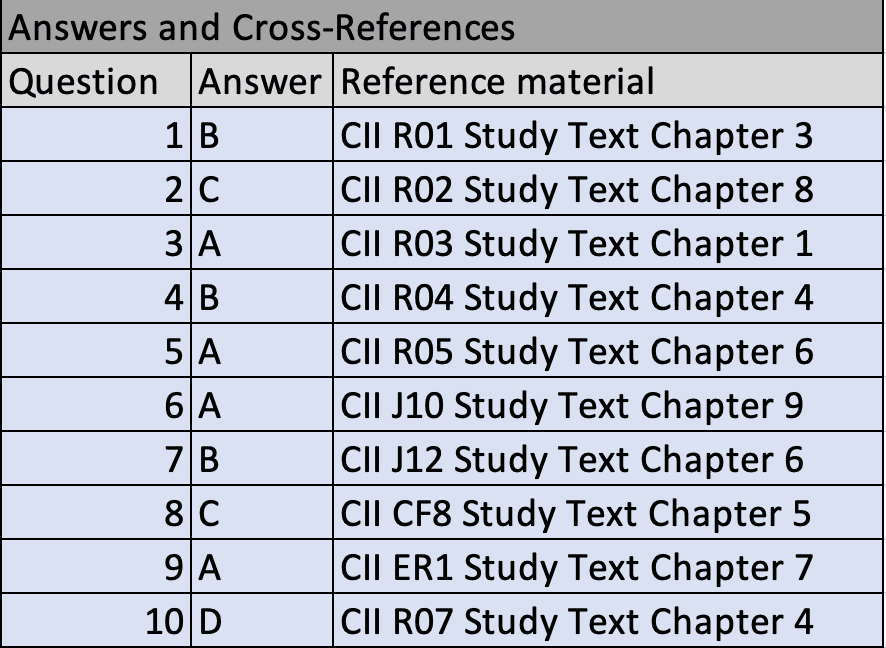
You will find the answers at the bottom of the page.
Questions
1. Comil Ltd are in serious financial trouble with borrowings up and sales down. What are the key alternatives for a company such as Comil Ltd facing liquidation?
A. Bankruptcy or winding the company up
B. Administration or a voluntary arrangement
C. Disqualification or removing the company from the Registrar of Companies
D. Appoint a solvency practitioner or Official Receiver
2. Joseph is interested in investing in derivatives. As his financial adviser, you tell him that these are:
A. financial instruments used to provide market stability.
B. specialist investments to provide increased speculative opportunities.
C. financial contracts whose value is derived from the value of an underlying investment.
D. instruments that allow investors exposure to underlying assets through direct ownership
3. Robert is 48 and has total earnings of £10,000 and gross interest from his building society account of £4,000. What is his total income tax liability in this tax year?
A. £0
B. £86
C. £186
D. £286
4. Evelyn wishes to make a complaint against her former employer in relation to incorrect administration of the occupational pension scheme. Who should she complain to?
A. The Pensions Advisory Service
B. The Pensions Ombudsman
C. The Pensions Regulator
D. The Financial Ombudsman Service
5. In calculating the maximum benefit payable under an income protection policy, some companies include which of the following to the definition of ‘total IP benefits’?
A. State disability benefits and sick pay from an employer
B. State disability benefits
C. Sick pay from an employer
D. Compensation payments received for accidents at work
6. Modern Portfolio Theory categorises risk as being one of two types: systematic and non-systematic. Non-systematic is the risk:
A. of a single financial institution defaulting.
B. of disruption throughout the financial system.
C. of not achieving a financial target.
D. that returns will be affected by stagnant growth.
7. A trade has been executed over the telephone by a member broker. When must the trade be reported to the exchange?
A. Within 1 minute of execution
B. Within 3 minutes of execution
C. At the end of automatic trading ie 4.30pm
D. By the time the LSE system finishes running ie 5.15pm
8. Edna has been advised to release some of the equity in her property by taking out a Home Reversion Plan. What is considered a serious restriction of plans of this type?
A. Only lump sum plans are available
B. The provider can ask Edna to move out of the property at any time
C. Edna is only likely to receive 1/3rd to 2/3rds of the value of her property
D. Edna may be required to pay a ‘peppercorn’ rent
9. Dolores, aged 70, is single and owns a property valued at £400,000. She has a good level of pension income which is index linked. If she takes out a lifetime mortgage for £75,000 and gifts the proceeds to her three nephews and nieces, which tax is she potentially avoiding?
A. Inheritance Tax
B. Capital Gains Tax
C. Council Tax
D. Income Tax
10. Local authority and environment searches are otherwise known as what type of cost?
A. Completion
B. Exchange
C. Mortgagor
D. Disbursement