






















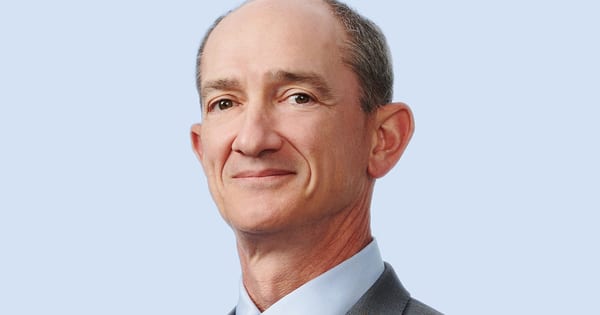
In the latest podcast from FundCalbre, they explore the structural changes reshaping global markets and why politics is only part of the story. Alec Cutler, manager of the Orbis Global Balanced and Global Cautious funds, looks beyond the headline AI winners to the companies enabling the technology revolution.
The discussion examines how deglobalisation, higher interest rates and renewed focus on energy, defence and industrial policy are changing investment opportunities.
Alec shares why the energy transition could remain inflationary, and explores opportunities in emerging markets and fixed income.
The team examine how a valuation-driven investment approach helps build resilient portfolios capable of navigating changing market environments and shifting investor sentiment.
Why you should listen to the interview: This conversation challenges many of today’s investment narratives. Rather than focusing on daily headlines, it explores the deeper structural changes driving markets.
From AI infrastructure and energy security to valuation opportunities in emerging markets, offering a fresh perspective on where investors may be overlooking long-term opportunities.
This interview was recorded on 24 June 2026. Please note, answers are edited and condensed for clarity. To gain a fuller understanding and clearer context, please listen to the full interview.
Interview highlights:
Why Trump is the symptom
“Trump is a manifestation of populism being on the rise. Why is populism on the rise? Populism is on the rise because people don’t feel good about the environment they’re in.
“They don’t feel good about the deal they’ve been given by their government, and they want change. We’re seeing it in other countries as well, so that’s one aspect of it, and that’s part of what drives Trump on a daily basis.
“The other is that we had it good for too long. The Western world, the developed world, had it good for too long. From the fall of the Berlin Wall we had peace.
“From the peak in interest rates in the early eighties we’ve had ever-dropping interest rates, which produced a wonderful tailwind. We had goods that were ever cheaper as we outsourced around the world and embraced globalism.
“All of those things have been reversing, ending, crashing, burning. Things are getting more expensive. Interest rates are going up. Globalisation is being reversed. Countries are necessarily focusing on becoming more self-reliant or having to focus on the bottom of what we call the Pyramid of Needs for a nation.
“The foundational blocks of what you need to have a successful country. Things like national defence, energy security, food security and industrial policy that gives you industrial security.
“You can’t have the top of the pyramid – the fun stuff – without that bottom stuff being intact. For too many years we’ve almost been mortgaging those foundational elements, striving even harder to have more fun, to be focused on self-realisation, self-actualisation and entertainment.”
The AI story nobody was talking about
“The fact is that you can’t do AI today, or for the next 15 or 20 years in many countries, without using natural gas to make electricity. But that’s a pretty complicated story to tell.
“It’s not exciting, it’s not a pure AI story, and it’s not something where a natural gas company is going to say, ‘We do AI.’ They’ll say, ‘AI is one of our customers, and it happens to be a customer that’s growing really rapidly,’ but that’s just not a news-breaking story for the media.
“Similarly, semiconductors have been quite popular recently, but for the first two or three years of AI there was no association between AI and RAM, flash memory, high-bandwidth memory or Taiwan Semiconductor – the makers of all the bits that go into the thing that NVIDIA sells.
“The fascination with AI stopped at NVIDIA, and it was great for us because it enabled us to build very large positions in the true enablers, the underlying enablers, of AI. Those are big positions that we hold through to today.”
Why emerging markets aren’t the risky part of the portfolio
“One of the things that’s kind of popping out to us is what we like to call emerging markets behaving like developed markets should, and developed markets behaving like emerging markets used to.
“Brazil is running a much lower deficit than the United States. It has lower debt-to-GDP than the United States. It has structural barriers to overspending that the US doesn’t have.
“The US, on the other hand, is running a wartime level of deficit and has debt-to-GDP approaching 120%, which is kind of red-lining. We can’t see a way, or the political will, to unwind that scenario.
“The US is spending more on interest expense on the national debt than on defence. Throughout history that’s a really bad setup. It’s a precursor to the fall part of the rise and fall of nations. Brazil doesn’t have that problem.
“People look at us and say, ‘You’re running a global moderate-risk multi-asset fund. Isn’t holding positions in Brazil risky?’ Yeah, but we think we’re being compensated for that risk more than adequately.”
A value revival
“Seeing the formerly blue-chip, top-of-the-line growth sectors come down a lot, get cheap and come into our universe is a super big positive for us.
“It’s not a positive for those who held the securities beforehand, but the entire software space has come down into our range finder. Consumer staples, luxury goods and biotech have all become interesting to us.
“That’s important not just because we have more opportunities to look at, but because it’s indicative of a value cycle. You get rotation. Industries and sectors become valuable, become fully valued and then get taken out and shot. The valuations get down to levels where value investors can buy them.
“Four years ago we bought into the non-US defence sector at four, five and six times earnings. We were selling those names at 25 or 30 times earnings. Today we’re buying biotechs at big discounts to book value and to our perception of their probable future cash flows.
“That’s a typical value cycle. If it means we’re entering a value cycle after 14 years of a post-GFC growth cycle, that’s a wonderful position for us to be in. That is our nirvana.”
Conclusion: While headlines continue to dominate market commentary, this discussion reminds us that lasting investment opportunities often emerge from deeper structural trends.
Whether it’s energy security, AI infrastructure, changing global trade or shifting valuations, the conversation highlights the importance of looking beyond short-term noise.
Past performance is not a reliable guide to future returns. You may not get back the amount originally invested, and tax rules can change over time. The writer’s views are their own and do not constitute financial advice.
This information should not be relied upon by retail clients or investment professionals. Reference to any particular investment does not constitute a recommendation to buy or sell the investment.
Main image: technology, AI, robynne-o-HOrhCnQsxnQ-unsplash