




















Concentrated benchmarks, growing scrutiny on value for money and a more volatile geopolitical backdrop make the case for a core strategy that seeks to deliver market returns plus something extra, in a risk-controlled way – says Nick Millington, Head of Systematic Index Solutions at Aberdeen Investments.

Over the last 12–18 months, three factors have come together. Equity markets have increasingly become concentrated, investors are looking harder at what they pay for their strategies, and the geopolitical backdrop has become more volatile.
Enhanced index approach addresses all three without asking investors to give up the market exposure they want when building their portfolios.
Concentration: not a new phenomenon
Cap-weighted indices have been concentrated recently, but that is not new; these dynamics come and go. In the past, concentration was driven by large banking or oil sectors; today, it is driven by AI-related companies.
The names change, the mechanism does not: a handful of similar companies drive a growing share of the benchmark’s return, and more concentrated strategies may be forced into very large geographic or single-stock positions.
Enhanced index approach works the other way round. Most investors are benchmarked or compared to these indices, so what they want is that benchmark with the potential for additional returns.
That requires a detailed understanding of the benchmark, with a view on every stock, so that the potential sources of excess return can be distributed across all the names in the index rather than a small number of concentrated positions.
A backdrop that amplifies volatility
The second driver is geopolitics. The chart below, built on the Geopolitical Risk Index by Caldara and Iacoviello, shows tensions that have become more frequent and more abrupt.
After the peaks of Russia’s full-scale invasion of Ukraine and the Iran-Israel 12-day war, the daily reading around the US-Iran escalation, marks the highest value of the entire series, close to 600 (1985 = 100).
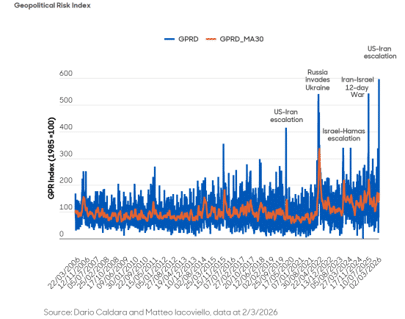
Such volatility can have a significant positive or negative impact on returns. For a portfolio that stays close to its benchmark, the point is that the result should come from stock selection and not from unintended exposures, such as sensitivity to a Middle East conflict or to trade policy and tariffs. Where such exposures are identified, the portfolio can be adjusted accordingly.
Scrutiny on value for money
The third driver is closer scrutiny of fees and investment outcomes, particularly in traditional active management. Enhanced index is a core strategy: it delivers the market return investors want, alongside the potential for excess returns, in a risk-controlled way, with transparency and at a competitive cost.
Some clients are moving from active to an approach with tighter risk controls; others come from passive, seeking a similar risk profile with the potential for additional returns. For those building their own multi-asset propositions, it is a building block.
Why emerging markets
Against this backdrop, emerging markets offer significant potential as a source of future returns. The term covers many countries, diverse economies and a broad universe of listed companies, so the opportunity set is vast compared with more traditional developed markets.
Quality matters here. In developed markets, companies that spend heavily on capex often disappoint on the returns on that capital. In emerging markets there is more opportunity in improving companies, with improving profitability and fundamentals. That is why the quality factor is specialised for emerging markets and complemented by valuation and momentum.
The underlying principle is to identify high-quality companies at attractive valuations, with momentum providing confirmation as market prices begin to reflect their potential. The three return drivers do not behave identically: each has its own profile of returns, and it is the combination that makes them compelling.
How to tell a robust strategy from a relabelled one
For fund selectors, the first step is to understand how the factors are built. A naive valuation measure makes utilities look cheap and IT companies expensive, and a portfolio based solely on this measure could exclude IT companies altogether.
A sounder approach compares companies with similar business models, within similar regions and industries, favouring stronger companies and avoiding weaker peers.
The second is consistency. A portfolio that is not rebalanced drifts, and risk exposures can increase unintentionally, leaving unrewarded risk where there is no view. A consistent risk budget and regular rebalancing help mitigate that risk.
The third is a track record. Many players competing in this space are new to it or rely on a backtest, a simulation of what a strategy might look like. A live track record shows how a process has performed through different interest rate regimes, financial crises and Brexit, and not just in the current environment.
The fourth is realistic expectations. Outperforming by half of 1% is not the same as outperforming by 5%, and the expected level of risk and return should be clear from the start.
Tools, not a strategy
In conclusion, systematic and quantitative techniques are not a strategy in themselves, but a set of tools to identify good companies and build efficient portfolios, concentrated where there is a view and avoiding risk where there is none.
The same goes for machine learning and AI: they support fundamental investment objectives and demonstrate that returns come from views and not from unintended sources of risk. There are different approaches to enhanced index, from pure quantitative to hybrid models that bring in fundamental research, and they can be complementary.
For investors, the essential question remains whether excess returns are driven by identifiable investment decisions rather than unintended risk exposures.
Past performance is not a reliable guide to future returns. You may not get back the amount originally invested, and tax rules can change over time. The writer’s views are their own at the date of publishing and do not constitute financial advice.
This information should not be relied upon by retail clients or investment professionals. Reference to any particular investment does not constitute a recommendation to buy or sell the investment.
Main image: background, blue, pawel-czerwinski