























Risk-targeted funds are designed to help match portfolios to a client’s chosen level of risk while maintaining consistency over time. In this article, Keyridge explains how volatility targeting works in practice and why a disciplined approach to risk management can support long-term investment outcomes.
Risk targeted funds are funds managed to target a clearly defined risk profile, giving advisers a practical way to align client portfolios to a chosen risk level while seeking to maximise long-term growth potential within that risk budget.
How can risk targeting be achieved?
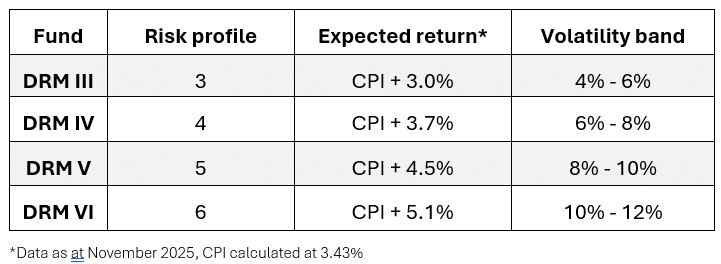
To create risk-targeted portfolios, some fund ranges, such as the WS Keyridge Diversified Risk Managed range, employ volatility targeting, whereby funds are managed to stay within specific expected volatility parameters and therefore maintain a static risk profile as defined by the third-party risk profilers, Defaqto.
The range spans the risk profiles from 3-6, to meet differing investor risk appetites. Each fund is designed to sit within a specific, internally-determined, two-percentage point-volatility band as shown, and we try to maximise returns within these bands.
Why is risk targeting important?
Without targeting a specific volatility range, funds can be susceptible to excessive movements up and down the risk scale depending on the proportion of risk assets held, and the changing volatility of risk assets in the fund.
Managing to a clearly defined risk level through targeting a specific volatility range helps advisers align clients to an appropriate portfolio and for it maintain consistency through time.
How do we aim to ensure that the funds stay within volatility bandings (and therefore the targeted risk bands) over the longer term?
At the core of portfolio construction within the DRM range is a clearly defined strategic asset allocation (SAA), which is applied consistently across the range.
Changes to the SAA are driven primarily by updates to the underlying assumptions rather than short‑term market views.
As part of the SAA process, the team considers the implications for portfolio risk characteristics, including volatility and risk ratings, to ensure that portfolios remain within their defined risk bands and continue to align with their intended objectives and target markets.
Throughout this process, our Investment Risk Team provides independent input and challenge, reviewing the proposed allocations and helping to ensure that the risk profile of the SAA remains appropriate, robust, and consistent with the design of the funds.
How can volatility targeting contribute to fund performance?
Managing to a defined volatility target rather than fixed equity and bond allocations allows the fund manager to express asset allocation more flexibly while remaining aligned with the fund’s objective.
This supports the team’s aim of maximising returns while helping to deliver a smooth investment journey.
The team continually monitors portfolios and volatility, adjusting exposures as markets move, to help ensure that the overall experience remains controlled and predictable.
Are there other ways of banding risk and how do they differ from risk targeting?
Another way of banding risk is risk profiling, whereby funds are built to align with externally defined risk-profile allocations. This is the approach taken by the other Keyridge multi-asset fund range, the WS Keyridge Portfolio Funds.
Each of the five funds offers a specific risk level (from 3-7) by investing in a different blend of global asset classes, to match different risk appetites.
We work in partnership with risk profiler Dynamic Planner to determine asset allocations for each risk profile. We review and, if necessary, rebalance each risk-profiled portfolio daily to ensure that it is achieving its aims and risk-profile allocations.
The value of investments may fall as well as rise and investors may not get back the amount invested.
The information contained in this document is provided for use by professional advisers and is not for onward distribution to, or to be relied upon by, retail investors.
The views expressed in this document are those of the fund manager at the time of publication and should not be taken as advice, a forecast or a recommendation to buy or sell securities. These views are subject to change at any time without notice.
No guarantee, warranty or representation (express or implied) is given as to the document’s accuracy or completeness. This document is issued for information only by Keyridge Asset Management.
Keyridge Asset Management Limited, trading as Irish Life Investment Managers and trading as Setanta Asset Management, is authorised and regulated as an investment firm by the Central Bank of Ireland. Keyridge Asset Management Limited is registered in Ireland. Registered office is Irish Life Centre, Lower Abbey Street, Dublin 1, Dublin, Ireland (Company registration number: 116000). Keyridge Asset Management Limited is authorised and regulated by the Financial Conduct Authority to provide investment services in the UK through a UK branch.
Keyridge Asset Management Limited is also registered as an Investment Adviser with the Securities and Exchange Commission and holds the International Adviser Exemption in Manitoba, Ontario and Quebec pursuant to NI 31-103.
Main image: lightbulb, blue, nejc-soklic-wO42Rmamef8-unsplash-2