























The standard and residence (where available) NRBs are frozen now until 2031 unless there are further announcements made – Julia Peake, Technical Manager at Nucleus lays out what some of this means and why it is ever more important to plan early with your clients.

This is one reason annual inheritance tax receipts received by the Treasury continue to rise. However, it also provides certainty about the allowances available when discussing planning options with clients.
Something we should be looking for when analysing client files, is whether clients are making full use of the allowances and planning opportunities available.
Conversations about estate planning and death can be difficult, but they are increasingly necessary, particularly as more assets, such as unused pension funds, could fall within the scope of IHT
For clients with a potential IHT liability, consideration should be given as to whether all available gifting exemptions and allowances are being used effectively. Although many of these have remained unchanged for decades, they still form an important part of effective estate planning.
Where gifting above the available exemptions is both suitable and affordable, the tax treatment will depend on the type of gift made.
Outright gifts to individuals and into bare trusts are treated as potentially exempt transfers (PETs), while gifts into discretionary trusts and interest in possession trusts created after March 2006 are chargeable lifetime transfers (CLTs).
Both will remain in the estate for seven years, but only CLTs can create a lifetime IHT charge where the available nil rate band is exceeded.
The earlier the conversations that can be had about planning for the future and making gifts, the more time the NRB can potentially be used for chargeable gifts.
The Office for National Statistics (ONS) has recently updated its life expectancy data [1] and calculator.
Average life expectancy in the UK is currently 79 for men and 83 for women, reinforcing the importance of considering longevity when discussing generational wealth and planning.
Given some of the complexities around estate planning, advice in this area is paramount. Given women statistically live longer, and according to the Centre of Economic and Business Research, women are expected to hold 60% of the UK’s wealth at the end of 2025, we should be doing more to engage women with their finances.
Research from Unbiased [2] suggests women are less likely than men to seek financial advice, highlighting the need for communications and client conversations that speak inclusively to all clients
The ONS calculator [3] illustrates the average remaining life expectancy by current age.
The table below uses that data to show how many nil rate bands may potentially be used for lifetime gifting, assuming that individual survives the seven years, demonstrating earlier conversations could create significant tax savings.
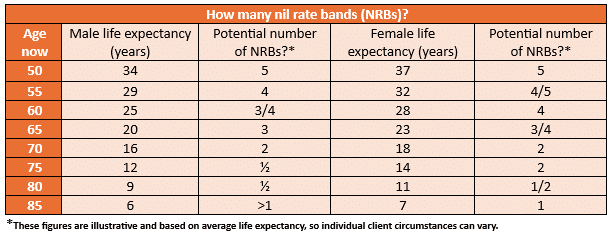
Using the table above, a married couple aged 55 who are willing and able to make gifts into discretionary trusts could potentially transfer £2.6 million over their lifetimes by using their nil rate bands.
If those same gifts were delayed by 15 years, the figure could fall to £1.3 million, a 50% reduction, potentially leaving beneficiaries with £520,000 less after IHT.
This is, of course, a simplified example. Where clients qualify for the residence nil rate band (RNRB), that allowance may be tapered once the net estate exceeds £2 million.
It should also be noted that the net estate calculation for RNRB purposes differs from the IHT calculation. Gifts made within seven years are excluded, whereas assets qualifying for up to 100% agricultural or business relief are included.
Additionally, remember that the transferable NRB and RNRB may be available on second death. The amount available is based on the percentage of unused NRB/RNRB rather than a monetary amount.
For example, if the first spouse died 10 years earlier leaving 100% of their estate to the survivor, and the estate on second death then passed equally to their children, the personal representatives may be able to claim both full nil rate bands and both residence nil rate bands.
Subject to the relevant conditions and gifting history in the seven years before death, this could mean up to £1 million of combined allowances.
If only 50% of the first spouse’s estate had passed to the survivor, only 50% of the available allowances at the second death could be transferred and the value would depend on the time of second death so long as this was after 9 October 2007 for the NRB and after 5 April 2017 for the RNRB.
The cost of delay is clear, and it may become even greater when unused pension funds form part of more estates for IHT purposes.
Early discussions and planning can make a meaningful difference meaning more wealth directed to the client’s intended beneficiaries and not the Treasury.
Sources:
[1] Life expectancy for local areas of the UK – Office for National Statistics
[2] Unbiased research reveals financial engagement gap among UK women and men | Unbiased
[3] Life expectancy calculator – Office for National Statistics
Main image: property, towfiqu-barbhuiya-05XcCfTOzN4-unsplash