























Juliet Schooling Latter, research director at FundCalibre, examines the contrarian strategies of the WS Ruffer Diversified Return fund.

Since its launch in 1994, investment house Ruffer has never been shy about going against the grain. There are plenty of examples ranging from not holding banks, housing or commodity companies prior to the Global Financial Crisis (instead the firm held masses of Yen and Swiss Francs; using derivatives from 2016 onwards – something which paid off during Covid) or using Bitcoin back in 2020.
It’s a contrarian stance which has ultimately paid off – not many people would begrudge a return of 8.1 per cent per annum over three decades*. But the past year or so has raised many questions about performance.
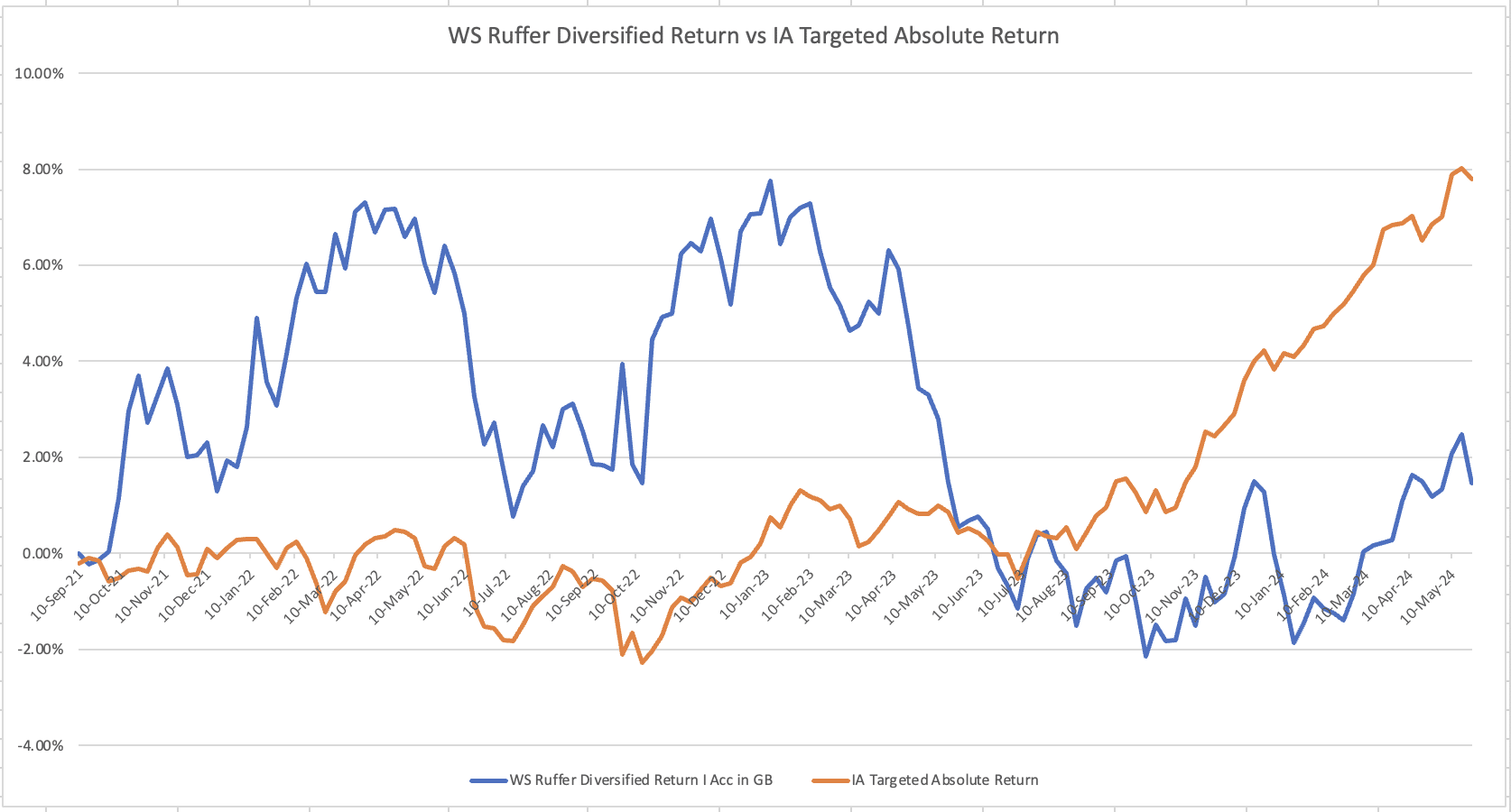
The firm launched the WS Ruffer Diversified Return fund in September 2021 as an extension of its wider strategy. Managed by investment directors Duncan MacInnes and Ian Rees, the launch was a response to a growing number of investors who wanted access to the strategy, but required greater liquidity and daily dealing.
Beyond this the strategy is unchanged. The fund aims not to lose money on any 12-month rolling basis, providing genuine protection in times of market stress. Asset allocation is the key driver of returns in the portfolio, which typically has 60-80 equities and 15-20 bond positions.
Sitting in the much-maligned Investment Association Targeted Absolute Return sector, for much of the life of this fund Ruffer has taken the view that markets were facing significant headwinds, be it the potential for rising rates early in the fund’s life to the apocalyptic concerns on markets in 2023.
Their pessimism had substance – not many would’ve expected rates to jump past 5 per cent in early-2023 and for markets to remain strong throughout the year – to the detriment of the performance of this fund.
Changes have been made – the cash and cash-related allocation is now below 30 per cent (it was around 50 per cent) and there is now a reasonable growth allocation. While the portfolio is more balanced – it retains a strong element of both caution and contrarianism.
“We feel we are the story of the ugly duckling. The sad little duckling peers do not accept it as it looks weird. We’ve been cast out into the wilderness, because of the weird and wonderful portfolio we have versus the conventional 60/40 with lots of Magnificent Seven companies.
“Clearly the ugly duckling story ends with it realising it is a beautiful swan and we feel that is the case with us,” says MacInnes.
Waiting for ugly ducklings to become swans
You only have to look at the portfolio to see those ducklings – Yen, inflation linked bonds, credit protection and volatility strategies, Chinese equities, value companies and commodities.
Commodities is the one investment that has come good recently. The likes of gold, silver and copper have all risen markedly year-to-date. It’s a move which has seen the portfolio up 2.5 per cent since the start of February 2024**.
The team currently hold around 15 per cent in the asset class***. This is through the likes of gold mining companies, an area MacInnes says looks incredibly attractive given the current price of physical gold. They also have positions in the likes of platinum and silver. Clearly the energy transition and electrification demands mean copper and other precious metals have a great upside.
MacInnes says: “M&A activity is also significant for these miners – all these stocks are buying each other rather than trying to provide new capacity. They are telling you that stocks are cheap and they’re scared or can’t put new capital in the ground, which will keep supply constrained.”
The move to a more balanced approach does not mean they exude any great optimism on markets, says MacInnes. He actually draws comparisons to 2019, describing them as “avalanche prone” with credit spreads and volatility back at pre-Covid lows.
He says: “There’s lots of high valuations and complacency – but it is not obvious what the catalyst would be to break this market. In 2021 it was clear it was going to be rate rises – today is anything but obvious, but when it does break we think it will be violent.”
Which takes us back to those ugly ducklings. MacInnes says they have already felt the benefit from the commodities play turning positive – a few more would put the fund in a very strong position. A good example is the 10 per cent holding in the Yen. MacInnes points to it remaining at a 50-year low, despite numerous catalysts for change (change of governor; end of yield curve control; and the end of negative interest rates) having come and gone.
“We underestimated the need for US rate cuts for this trade to work. But the appreciation in the Yen could be rapid – it’s one of the ugliest ducklings we have,” he adds.
MacInnes says the impact of rate cuts would help the portfolio in a number of ways – the fund has a bond duration of around 3 years and it should be positive for gold and certain equities. However, he believes the big lesson of the last two years has been that monetary policy lag has lasted longer than many thought.
He says: “S&P companies had already sorted their debt and consumers had fixed their mortgages – so when rates rose nobody felt the immediate pain. So if rates fall we’d expect the immediate benefits not to be so strong. The moves are likely to be sector specific.”
Ruffer has historically been the place to be when times get tough and we see no reason why this won’t be the case again. The firm has a well-rounded portfolio to take advantage across a number of sectors and assets.
*Source: Ruffer, net annualised returns
**Source: FE Analytics, total returns in sterling, from 1 February 2024 to 28 May 2024
***Source: Ruffer, May 2024
Past performance is not a reliable guide to future returns. You may not get back the amount originally invested, and tax rules can change over time. Juliet’s views are her own and do not constitute financial advice.