























Juliet Schooling Latter, research director, FundCalibre, continues her monthly articles for Professional Paraplanner examining funds or managers approaching three year track record, with a look at the Ninety One UK Special Situations fund.

“Sell everything?” That was the text I remember reading from a friend when I woke up on 24 June 2016 as the UK dramatically voted to leave the EU.
That was a very stressful day for anyone in the industry, but while the malaise on Brexit has started to clear, sentiment on UK equities has not. I recently read UK domestic stocks are now trading at a 45 per cent discount to global peers, prompting headlines the UK economy is worse than Japan’s in the 1990’s. If so, seven years’ of waiting is just the start.
“Eventually someone is going to buy UK stocks, but we try and be proactive and remove the problem. There are plenty of sectors like banks and oil majors where you look at the distribution yields (the combination of dividends and buybacks) and if you add them together you get over 10 per cent of your market cap back as cash.
“As long as that is the case, you don’t really need a big swing in sentiment to make a satisfactory return. We’d prefer the stock to rise, but it’s not dead money. The UK is nothing like Japan – investors are being paid well to wait.”
That’s the view of Ninety One UK Special Situations co-manager Alessandro Dicorrado – who believes it is not all gloom for the UK economy. Alessandro and co-manager Steve Woolley took over this fund from renowned contrarian investor Alastair Mundy in April 2020, having worked with him and the value team for almost a decade.
You would’ve thought taking over at the height of Covid was a baptism of fire – in reality Alessandro says it was a great opportunity as the market was full of attractive options for contrarian investors.
A couple of slight tweaks were immediately made to the investment process – resulting in a 30 per cent turnover in the fund. Previously, the portfolio was beholden to a screen, which looked for stocks which had fallen 50 per cent or more. This was widened to consider stocks falling 40-45 per cent, with the same attractive characteristics.
Alessandro says the 50 per cent screen sometimes offered them limited options, with the move opening up further avenues. A good example was insurance company Beazley, which they felt was a great specialist insurer in numerous areas like cyber security.
“The previous style was also more benchmark aware. So we removed a few index stocks that were held as proxies for not having enough good ideas,” he adds.
The team undertakes detailed fundamental analysis, sifting out the genuinely troubled businesses from those which have been misunderstood by the market. The managers believe these companies are seldom out-of-favour forever and can generate strong returns as they are rehabilitated.
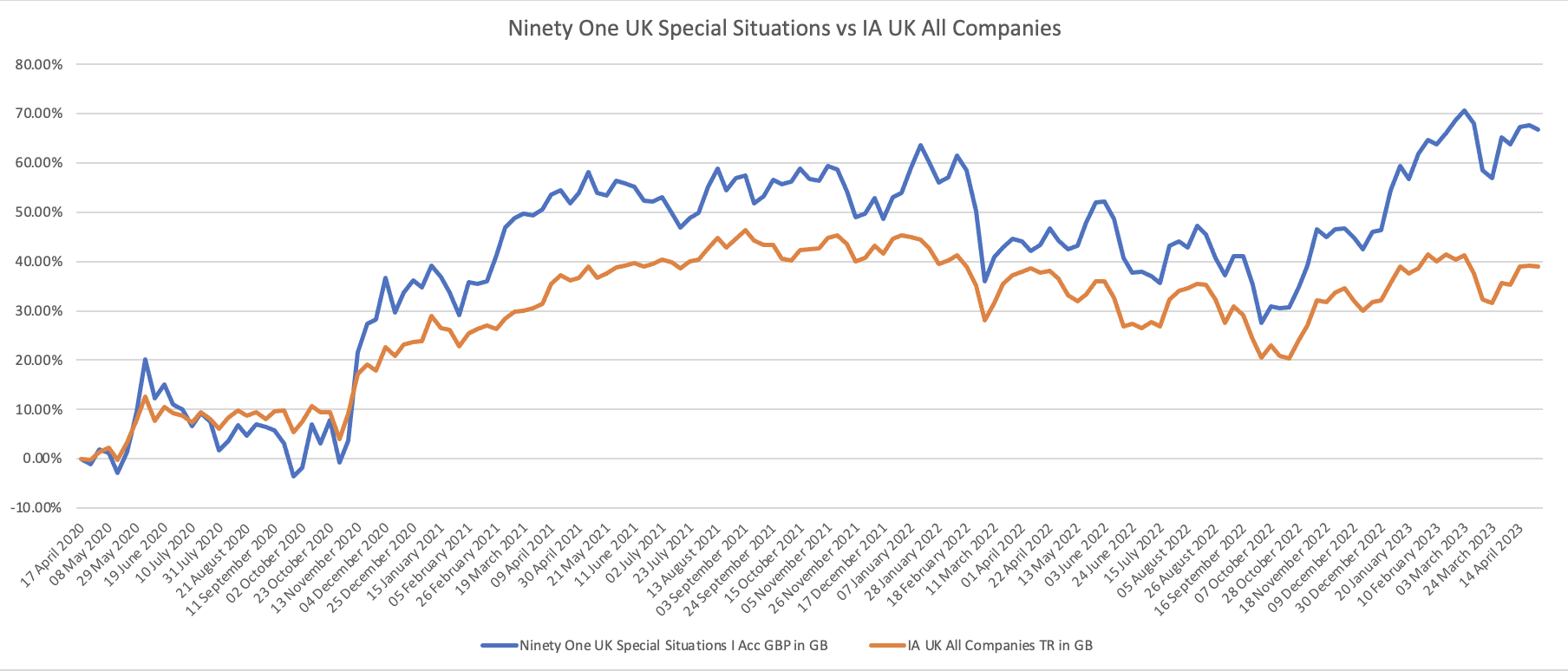
The proof is in the pudding. Since taking over, the fund is now up 67 per cent, almost double the average of the Investment Association UK All Companies sector.
Of course, the rejuvenation of value as an investing style has helped. Alessandro points to the amazing one week vaccine rally in November 2020 as an example but adds that, in reality, the discount in UK equities only closed 20-30 per cent, meaning there is still a major gap to be closed.
He says: “Take EasyJet as an example. It used to trade at £10, troughed at around £3 and now it is trading at £5. We do feel it is worth around £10 so it shows how much the discount has to close if we are right. People have forgotten how much these companies actually earn – just look at the EasyJet profit margin in 2018-19 and it is easily worth £10. But it has not had a clean year, without challenges, since then.”
Alessandro believes a lot of value investors are wrong to associate their fortunes with rising inflation, adding that the evidence for this has only been true for the past decade or so. By the same token, he also believes the market has been too quick to rebound towards growth amid expectations that inflation/rates will fall quickly from here.
He says: “The trade of the past 10 years of going to growth when rates come down might be the right call again, but I think once inflation hits food prices and wages – as it has – it will take a lot longer to work through the cycle. If that happens, the re-rating we’ve seen at the start of the year won’t last.”
Ultimately, Alessandro feels the change in sentiment towards UK equities will come from overseas, but he says there are still plenty of opportunities to be found in the meantime – for example their recent addition of auto-parts provider TI Fluid Systems.
He says: “The people who invest in UK value must have a big contrarian streak – patience is the key, but remember, you are being paid well in the meantime.”
*Source: FE fundinfo, total returns in sterling, 20 April 2020 to 5 May 2023
Past performance is not a reliable guide to future returns. You may not get back the amount originally invested, and tax rules can change over time. The views expressed are those of the author and fund manager and do not constitute financial advice.
[Main image: jack-paul-fiedler-MKaQ4KOEssk-unsplash]