

















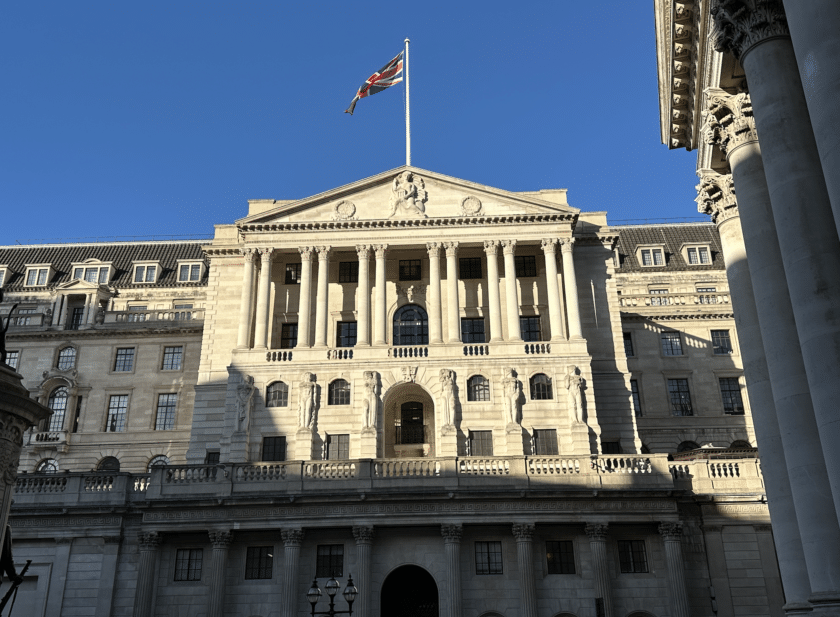
The Bank of England has held interest rates steady at 3.75% for the sixth time in a row, despite rising inflation.
The Monetary Policy Committee voted by a majority of 6-3 to maintain the rate, with three members voting to increase the rate to 4%.
Conflict in the Middle East has disrupted the transportation and supply of energy, raising its price and pushing up households’ motor fuel costs and utility bills, with the latest government figures showing inflation rose to 3.1% in August.
However, commenting on the Bank’s decision, governor Andrew Bailey said so far, higher energy costs have had a limited effect on price and wage setting in the UK.
However, he warned that the longer volatility persists, the bigger the impact on inflation and the more likely it is the Bank will need to raise the interest rate to ensure that inflation falls back to its 2% target.
In a statement, the MPC said: “The Committee stands ready to act as necessary to ensure that CPI inflation remains on track to meet the 2% target in the medium term.”
Sarah Coles, head of personal finance at AJ Bell, said: “Don’t get comfortable. The Bank has chosen not to move today, partly because wage rises are still relatively modest. Given that growth is still sluggish, the MPC doesn’t want to jump too soon and dampen potential growth prospects in the coming months.
“However, the pressure is building. The MPC said there was little sign of second round effects through things like higher wages so far, but the longer that higher oil and gas prices endure, the bigger the risk they would start to materialise. It emphasised that it stands ready to act if needs be, which is a pretty big hint that rate rises could be on the cards in the coming months.
“The market now expects the first hike in November, a total of three by March and as many as five by July. The market has been wrong before – many times – so none of this is nailed on. However, it will already be having an impact on savings and mortgages.”
Lale Akoner, global market strategist at etoro, shared a similar sentiment: “The Bank of England has bought itself time, but we think that today’s decision points clearly towards tighter policy if the energy shock persists. With inflation expected to reach 4% early next year and growth holding up better than forecast, a November rate rise is now a serious possibility.
“For households, there is little prospect of cheaper borrowing anytime soon. People refinancing mortgages could face higher monthly payments just as energy bills rise, putting another squeeze on disposable incomes and consumer spending.”
Charlotte Kennedy, chartered financial planner at Rathbones, added: “The outlook remains uncertain, and economic shocks have a habit of arriving uninvited. The best defence is not trying to second-guess the Bank’s next move, but making sure your finances are robust enough to weather whatever comes next. That could mean strengthening emergency savings, paying down expensive debt and ensuring longer-term money is working hard enough to keep pace with inflation and support future financial goals.”
During the meeting, the MPC also voted unanimously to reduce the stock of UK government bond purchases held for monetary policy purposes, and financed by the issuance of central bank reserves, to zero.
It said this will be conducted through a multi-year plan so that remaining stock is unwound at an annual average pace of £46 billion by the end of 2034 through annual sales of £20 billion alongside maturing gilts.
Commenting on the announcement, Derrick Dunne, CEO of YOU Asset Management, said: “The most interesting detail today is the Bank of England’s decision to pause gilt sales. It will hold no more auctions until it sets out new arrangements, which are due by April 2027.
“The effect on the price of UK government debt will be modest, as the Bank estimates its QT programme has added around 0.2 to 0.3 percentage points to long-term borrowing costs.
“Even so, the pause gives some relief to a bond market under heavy pressure, and it runs through the Budget on 28 October. It is the first time the Bank has halted its gilt sales since it delayed their start in 2022.”